Satellite Images Reveal Massive Growth in Missile Sites
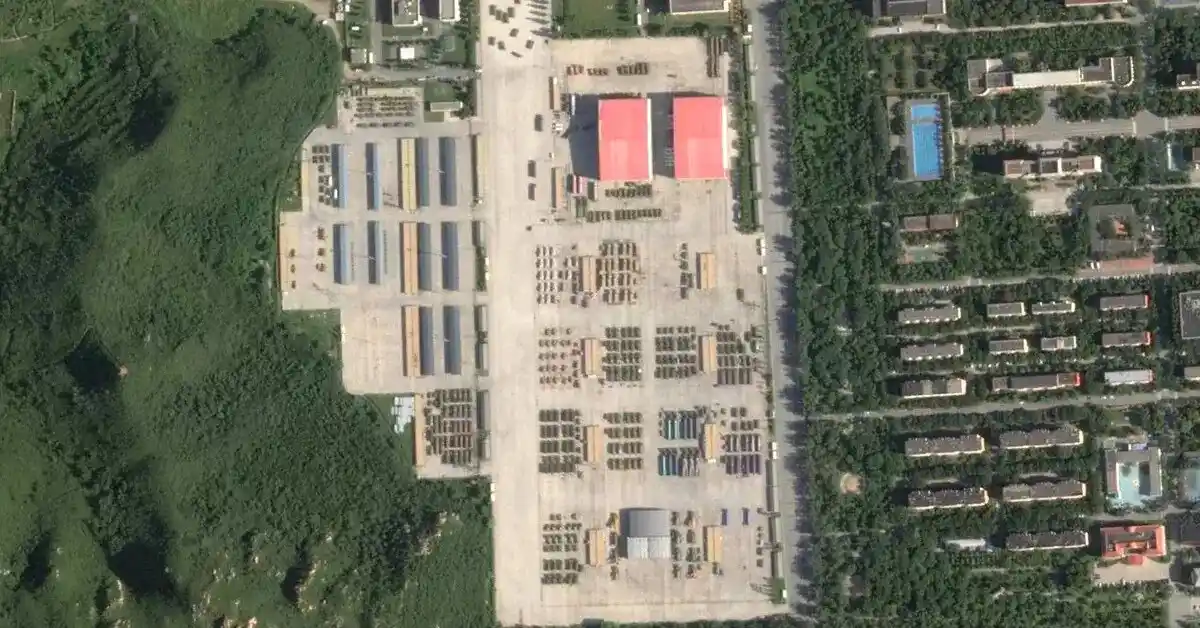
A new analysis of China’s missile production surge has revealed a dramatic expansion of military facilities since 2020. Satellite images, maps, and government records examined that China is rapidly scaling its missile manufacturing capacity—fueling what experts describe as a new arms race with the United States.
More than 60% of 136 facilities linked to missile production or the People’s Liberation Army Rocket Force (PLARF) show clear signs of expansion. These sites include advanced research centers, test facilities, and production complexes spread across China. In total, they have added more than 21 million square feet of new constructed floor space in just five years.
William Alberque, a senior adjunct fellow at the Pacific Forum and former NATO arms control director, called the buildup a defining moment. “China is positioning itself as a global superpower. We’re witnessing the early stages of a new arms race,” he said.
China’s Military Transformation Under Xi Jinping
Since taking power in 2012, President Xi Jinping has poured billions into strengthening China’s military. His long-term goal is to turn the People’s Liberation Army (PLA) into a world-class force capable of challenging US dominance in Asia.
Xi elevated the PLA Rocket Force to become a central pillar of China’s defense strategy. The Rocket Force oversees the nation’s expanding arsenal of nuclear and ballistic missiles. Xi has called it “a core of strategic deterrence and a cornerstone of national security.”
The investigation found that missile-related factories and test sites have replaced villages and farmland across China. Construction has accelerated since 2020, signaling a clear strategic shift toward large-scale weapons production.
Experts Warn of a New Arms Race
Military analysts say this rapid missile production surge highlights China’s plan to counter US influence in Asia. “They’re building capacity fast,” said Alberque. “China is sprinting toward dominance while preparing for a long-term standoff.”
The US, in contrast, faces serious supply issues. Washington’s defense industry struggles to keep pace as it continues supplying advanced systems to allies like Ukraine and Israel.
China’s rapid buildup now outpaces the US in several categories of conventional missile development. According to CNN’s review, at least 65 of 99 missile manufacturing sites have expanded since 2020. The Rocket Force itself has added new launch facilities and testing infrastructure.

Missiles Central to Taiwan Invasion Strategy
Experts believe the missiles produced at these expanding facilities are crucial to Beijing’s military plans for Taiwan. China views Taiwan as a breakaway province and has never ruled out taking it by force.
Decker Eveleth, an analyst at CNA specializing in Chinese missile forces, said, “The PLA wants to prepare the battlefield. They aim to destroy ports, air bases, and supply routes that could bring US support to Taiwan.”
The anti-access/area denial (A2/AD) strategy is central to this effort. By deploying advanced missiles along its coast, China hopes to keep the US Navy from intervening during any Taiwan conflict.
China’s Growing Nuclear Arsenal
China is also expanding its nuclear weapons program at an unprecedented pace. The Stockholm International Peace Research Institute (SIPRI) reported that China has been adding about 100 new nuclear warheads annually since 2023.
Though China’s total stockpile remains smaller than that of the US and Russia, experts warn that its growth rate is unmatched. The Union of Concerned Scientists estimates that China’s current arsenal could double within the next decade if the expansion continues.
Meanwhile, the US is reassessing its nuclear posture. President Donald Trump recently instructed the Pentagon to consider resuming nuclear testing “on an equal basis” with China and Russia—a major shift from decades of restraint.
Budget Surge and Global Concerns
In early 2025, China approved a 7.2% increase in defense spending, raising its official budget to roughly $245 billion. This marks the fourth consecutive year of defense spending above 7%, though analysts believe the actual figure is much higher.
By comparison, the US continues to divert missile stockpiles to foreign conflicts. During the June 2025 Iran-Israel war, America used nearly a quarter of its THAAD missile interceptors to defend Israel. The Pentagon later extended a $2 billion contract with Lockheed Martin to replenish the stock, but production remains slow.
These supply strains contrast sharply with China’s industrial acceleration. Experts argue that Beijing’s ability to mass-produce both cheap drones and sophisticated ballistic missiles could tilt the military balance in the Indo-Pacific.
Corruption and Challenges Inside the PLA
Despite the growth, China’s military faces internal challenges. A wide-reaching anti-corruption campaign has shaken the PLA, with several senior officers—including two defense ministers—removed in the past two years. Reports suggest corruption linked to the procurement of new missile systems.
A US defense official noted, “Beijing knows corruption threatens its operational readiness. They’re trying to clean house before scaling further.”
Even with these internal issues, China’s missile production surge continues to accelerate. Analysts warn that if current trends persist, the next decade could mark the beginning of a full-scale arms race between China and the US—a contest for technological, military, and strategic dominance in the Indo-Pacific.