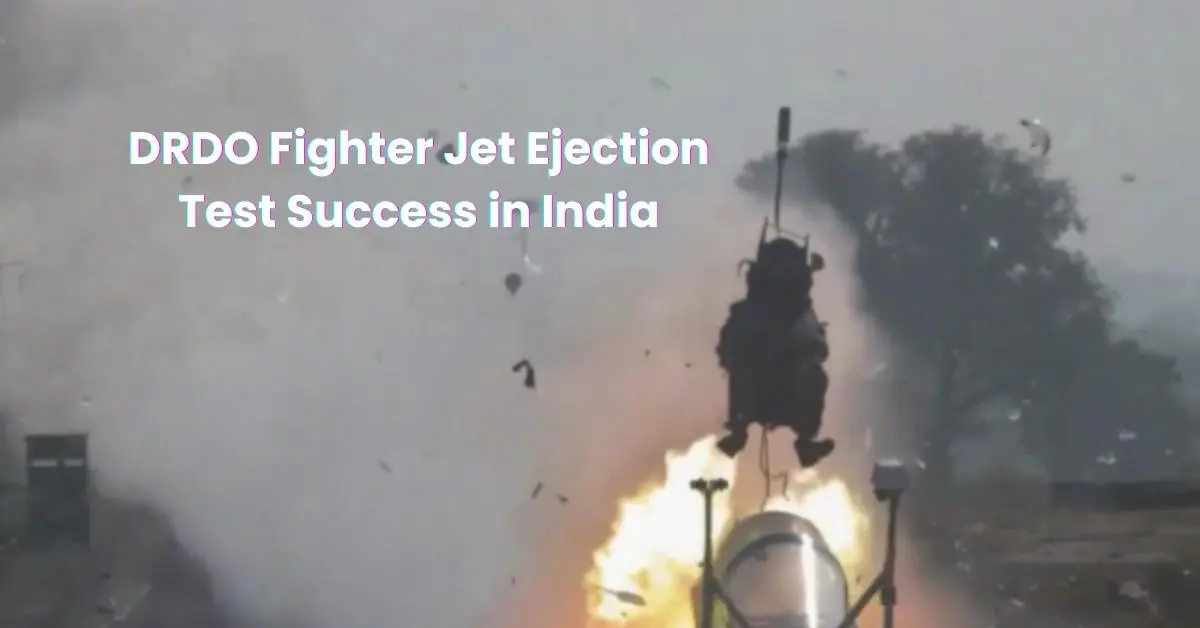
The DRDO fighter jet ejection trial has become a major highlight in India’s defence sector. DRDO conducted a high-speed rocket sled test that proved the accuracy and safety of India’s indigenous pilot escape technology. The system worked at extreme speed conditions, strengthening India’s confidence in its growing defence capabilities.
DRDO Fighter Jet Ejection Test Sets New Benchmark
The DRDO fighter jet ejection test took place at the Rail Track Rocket Sled (RTRS) facility in Chandigarh. Engineers pushed the escape system to a speed of 800 km/h. This helped them recreate the harsh conditions a pilot faces during an emergency.
A dummy pilot was strapped inside the test module. The rocket sled accelerated down the rail track, and the ejection seat fired at the planned moment. The dummy shot clear of the cockpit in a clean and controlled motion. The test team recorded the entire process to check every technical detail.
DRDO confirmed that the trial validated three major elements of a modern escape system: canopy separation, ejection timing, and crew recovery. Each part worked as planned, showing that the system can protect a pilot in real combat situations.
India’s Push for Safer, Smarter Fighter Jet Technology
Defence minister Rajnath Singh praised DRDO and its partners for the breakthrough. He said the success shows India’s strong progress toward defence self-reliance. Organisations like the Indian Air Force, HAL, and ADA worked with DRDO to bring the project to this stage.

This achievement adds momentum to India’s ongoing push for indigenous technology. The government continues to highlight how homegrown systems now support the nation’s military missions. DRDO’s progress strengthens the “Aatmanirbhar Bharat” vision and reduces India’s reliance on foreign equipment.
Earlier Achievements Strengthen India’s Defence Confidence
The ejection test follows other recent milestones. DRDO chairman Samir V Kamat earlier spoke about Operation Sindoor, a complex mission near the western border. He said India used several indigenous systems during the operation, including Akash missiles, BrahMos cruise missiles, anti-drone systems, and C4I platforms. These technologies worked with precision, proving India’s growing strength in modern warfare support systems.
Kamat also highlighted the important role of institutes like DIAT. Their research and training help build the talent required to develop world-class defence technology.
Conclusion
The successful DRDO fighter jet ejection test marks a major step toward safer skies for Indian pilots. It shows India’s ability to design and test critical life-saving systems on its own. With each milestone, the country moves closer to full defence independence and stronger national security.