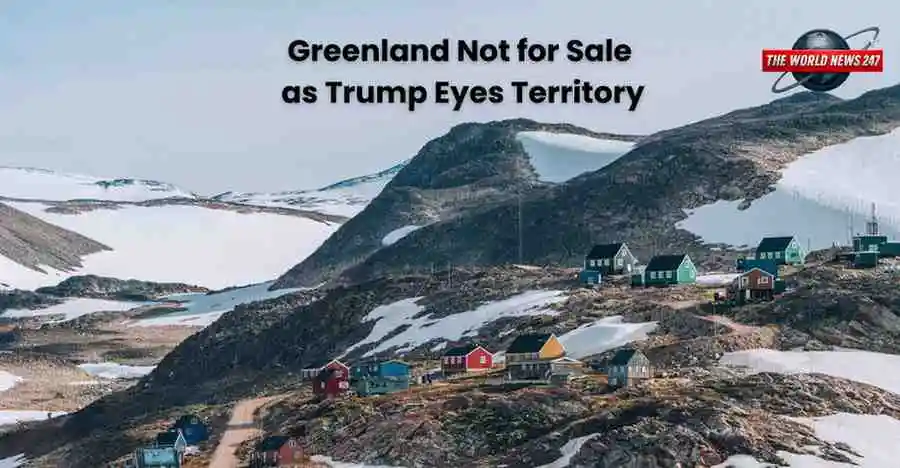
Greenland not for sale is the clear and unified message coming from the Arctic island as U.S. President Donald Trump once again raises the idea of acquiring the territory. From the very beginning, Greenlanders have pushed back strongly, expressing fear, frustration, and national pride. Although the proposal was first introduced during Trump’s presidency, its revival comes at a time of heightened global competition in the Arctic. Consequently, residents are making one thing unmistakably clear: their land, culture, and future are not commodities.
Greenland, an autonomous territory within the Kingdom of Denmark, holds immense geopolitical importance due to its location between North America and Europe. Moreover, the island is rich in natural resources and lies along emerging Arctic shipping routes. As a result, it has attracted growing international attention. However, for Greenlanders themselves, the renewed discussion is not about global strategy—it is about sovereignty, dignity, and respect.
Greenland Not for Sale: Fear of Losing Identity and Self-Determination
Many Greenlanders fear that outside interest reduces their homeland to a strategic asset rather than recognizing it as a living society with its own culture, history, and voice. As a result, community leaders and citizens alike have voiced concerns that such proposals undermine decades of progress toward self-governance and cultural preservation.
Furthermore, the notion that Greenland could be “bought” has sparked widespread indignation across social media and public discourse. Residents insist that decisions about Greenland’s future must be made by those who live there. In other words, foreign leaders viewing the island through an economic or military lens do not have that authority. For a population striving for greater political autonomy, the rhetoric feels dismissive and deeply unsettling.
Political Leaders Reinforce: Greenland Not for Sale
In response, Greenlandic officials have drawn a firm line, reiterating that Greenland not for sale is not a slogan but a principle. Likewise, Danish leaders have echoed this stance, pointing to international law and the right of Greenlanders to self-determination. Together, this unified response sends a strong signal to the international community.
At the same time, analysts acknowledge that renewed attention reflects Greenland’s rising importance in global affairs. Due to climate change, Arctic accessibility is increasing, which in turn elevates the region’s role in future trade routes, energy exploration, and security planning. Nevertheless, Greenlanders maintain that any international engagement must be built on partnership rather than ownership.
A Call for Respect, Not Possession
Ultimately, the backlash against Trump’s remarks highlights a deeper issue: the ongoing tension between global power politics and indigenous rights. While Greenland welcomes cooperation, investment, and dialogue, it does so only on terms that respect its autonomy and values.
As geopolitical competition intensifies in the Arctic, Greenland’s message remains consistent and unwavering. The island may be open to the world; however, Greenland not for sale—and never will be.