The US embassy’s posts on the recent Delhi blast and the Islamabad court explosion have triggered widespread debate on social media in India. Many users accused Washington of showing a double standard in how it describes terrorism in India versus Pakistan.
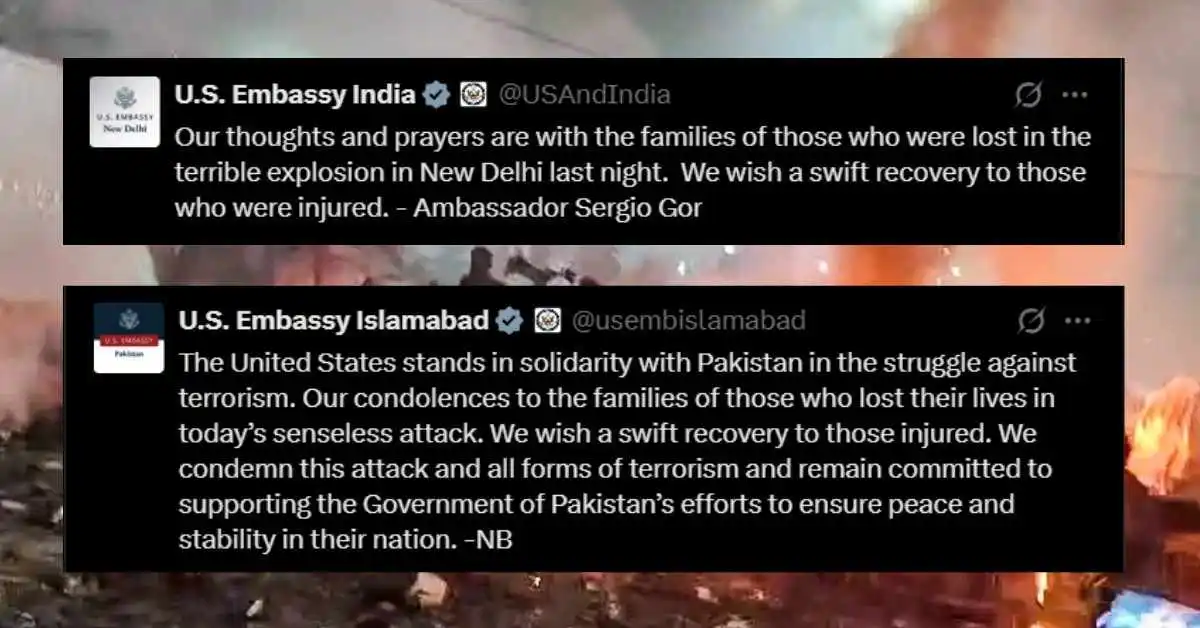
On Monday, a car bomb exploded near Delhi’s Red Fort, killing nine people and injuring several others. The next day, the US embassy in India posted condolences on X (formerly Twitter), saying its “thoughts and prayers” were with the victims of the “terrible explosion.” However, users quickly noticed that the post did not mention terrorism, even though the incident bore all hallmarks of a terror attack.
US Embassy Faces Backlash Over Its “Mild” Delhi Blast Statement
The US post on the Delhi blast came nearly 24 hours after the attack, sparking criticism for both its tone and timing. Commentators noted that the embassy used softer language to describe the Delhi incident, while it immediately condemned the Islamabad blast as “terrorism.”
In contrast, the US embassy in Pakistan wrote, “The United States stands in solidarity with Pakistan in the struggle against terrorism,” calling the court complex blast in Islamabad a “senseless attack.” This statement was released within hours of the incident, which many Indian users saw as a double standard in US diplomacy.
Social media users, including geopolitical analysts, argued that the US response to similar incidents differed based on the country involved. One user commented, “It took the US Embassy in India nearly a day to react, but they responded to the Pakistani attack within hours. Why the hesitation to call Delhi’s blast terrorism?”

Double Standards or Diplomatic Nuance?
The US has long described India as a key strategic and economic partner in the Indo-Pacific region. However, several incidents have raised questions about Washington’s approach toward New Delhi. Former R&AW chief Vikram Sood also cautioned against viewing the US as an entirely reliable ally. In a recent interview, he said India must study the US “more deeply” and understand its motives, not just through Western media narratives.
Sood suggested that while China remains an immediate threat, the US could become a “distant threat” due to its economic policies and self-serving diplomacy. He pointed out that Washington’s steep tariffs on Indian goods and selective engagement often reveal a desire to maintain global dominance.
India’s Reaction and Broader Implications
Public sentiment in India remains strong, with many calling for greater diplomatic assertiveness. Analysts say such selective wording from the US may affect public perception of Indo-US relations, even if it doesn’t alter strategic ties at the top level.
As the world grows more sensitive to language in diplomacy, the US will likely face more scrutiny for how it addresses terror-related incidents, especially in South Asia — a region where both India and Pakistan remain central to its counterterrorism agenda.