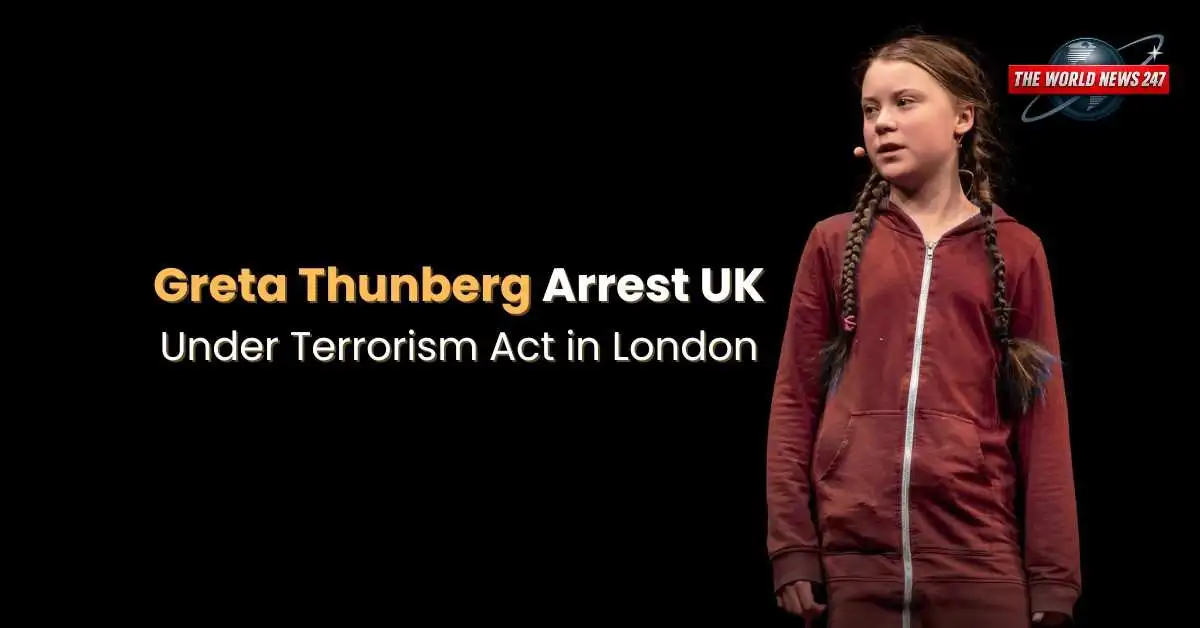
During a protest in central London about the war in Gaza, Greta Thunberg was stopped and taken away by police. After a review of her demonstration, officers said that she had shown a placard that “supported the people” (sic) “linked to Palestine Action, ” a group that is banned under UK law, and they took her into custody.
After the arrest, a spokesperson for the police said that it was made under Section 13 of the Terrorism Act 2000. This part of the act makes it a punishable offense to show support for an organization that has been proscribed. Police pointed out that the intervention was due to the message on the board, not because of any violence or disorder.
That very day, police also took into custody two men who had thrown red paint on the side of a building. Later, Thunberg showed up at the scene and after a short time with officers, she was taken away by them.
Why Was the Arrest Made Under Terrorism Laws?
According to UK regulation, police officers are empowered to take action against individuals who publicly express support for a group that has been banned. Once an organization is proscribed by the government, any form of support, even symbolic, becomes a punishable offense.
In the case of the Greta Thunberg arrest UK, the police claimed that the placard was the one that most directly referred to the prisoners that were linked to Palestine Action. It was that link that led to the arrest under the terrorism law.
On the one hand, legal experts say the law has enough provisions to work. On the other hand, critics say it drags the issue into a gray area between protest and extremism, especially in peaceful demonstrations.
Why Did the UK Ban Palestine Action?
The UK government banned Palestine Action in June 2025 after activists damaged military aircraft at a Royal Air Force base. According to officials, the move endangered national security and violated the law beyond the protest boundary.

The prohibition outlawed backing the group publicly. Openings for dissent rights organizations were on the ban side. They contend that the incidents constituted cases of criminal damage rather than terrorism.
There are still several court challenges to the ban.
Public Reaction to the Greta Thunberg Arrest UK Case
The arrest has led to a burst of very strong reactions on social media and among activists. Protesters consider that it illustrates a limited space for demonstration in the UK. On the other hand, some people hold the view that laws should be followed by everyone, irrespective of their status.
Human rights organizations express their concern that such detentions might intimidate the movement of peaceful activists. On the contrary, government officials are of the opinion that the law is there to ensure safety in public places.
The Greta Thunberg arrest UK event is presently referred to as a turning point in the extensive discussion about the right to protest and the use of counterterrorism powers.